
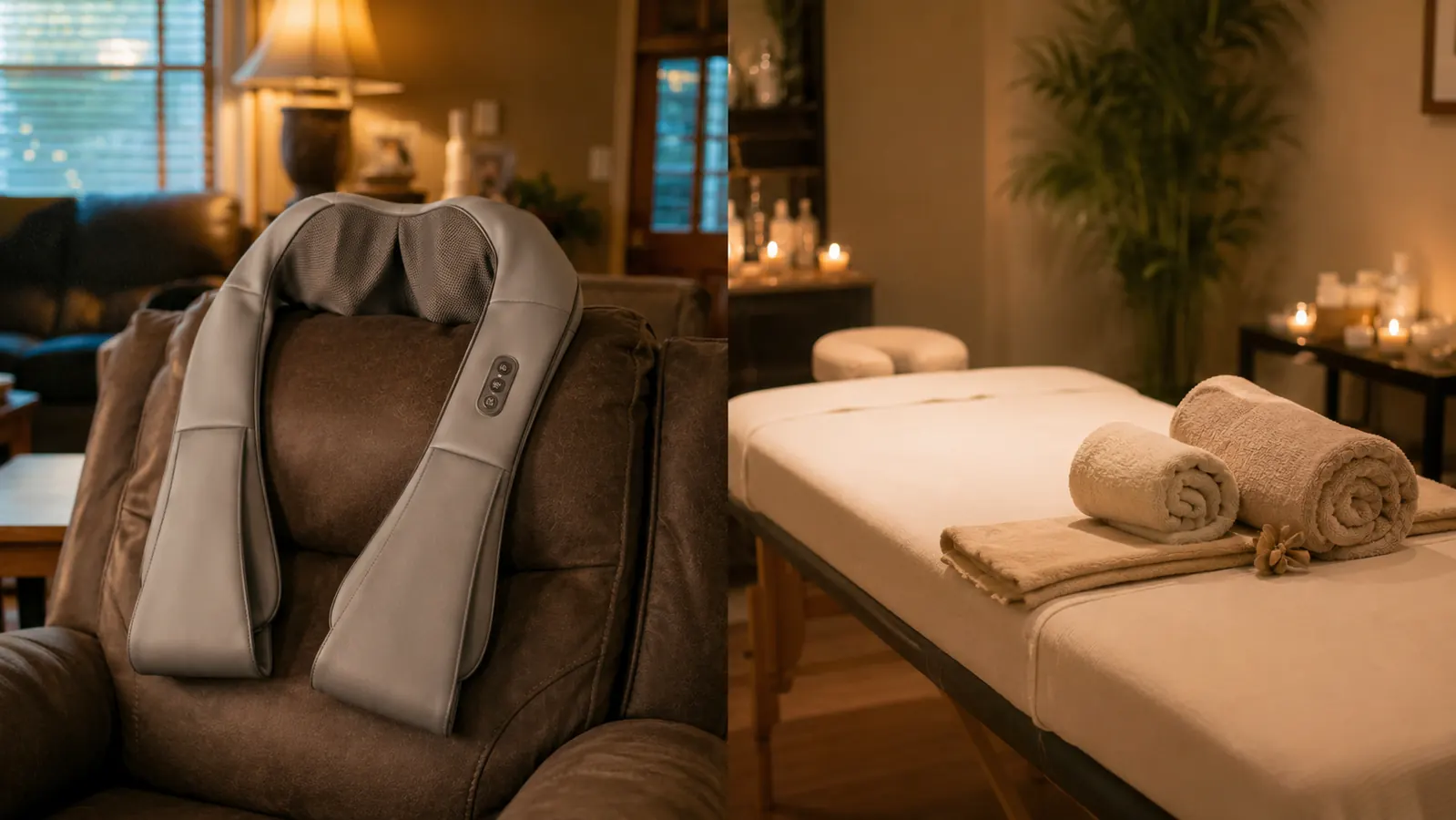
For about two years, a professional massage was my one real recovery expense. I'd work a full shift running maintenance crews, spend the weekend hauling gear in and out of the truck for a hunt or a fishing trip, and by the following Thursday my neck and shoulders would be locked up tight enough that turning my head to check a mirror felt like a decision. So I'd book an hour with a massage therapist about twenty minutes from the house, hand over my card, and walk out loose for about four or five days before the whole cycle started over again.
Short answer, since I know that's what you're here for: for the specific problem of tight neck and shoulder muscles from physical work, a Nekteck shiatsu neck massager with heat gets you real relief for a one-time cost, available the second you get home, no calendar required. A professional massage still does things the machine can't, mainly full-body work and a trained set of hands that finds knots you didn't know you had. They're not really competing for the same job. Here's the full breakdown of where each one earns its keep.
I'll say up front I still think professional massage is worth the money for some things, and I haven't cancelled it out of my life entirely. I'm not writing this to talk you out of ever booking one again. I'm writing it because I spent two years assuming a massage was the only real option for a tight neck, and it took actually buying a home unit and running it four nights a week for a couple months to realize how much of what I was paying for, I could get on a Tuesday night for the cost of running a small motor for twenty minutes.
| Shiatsu Neck Massager | a Professional Massage | |
|---|---|---|
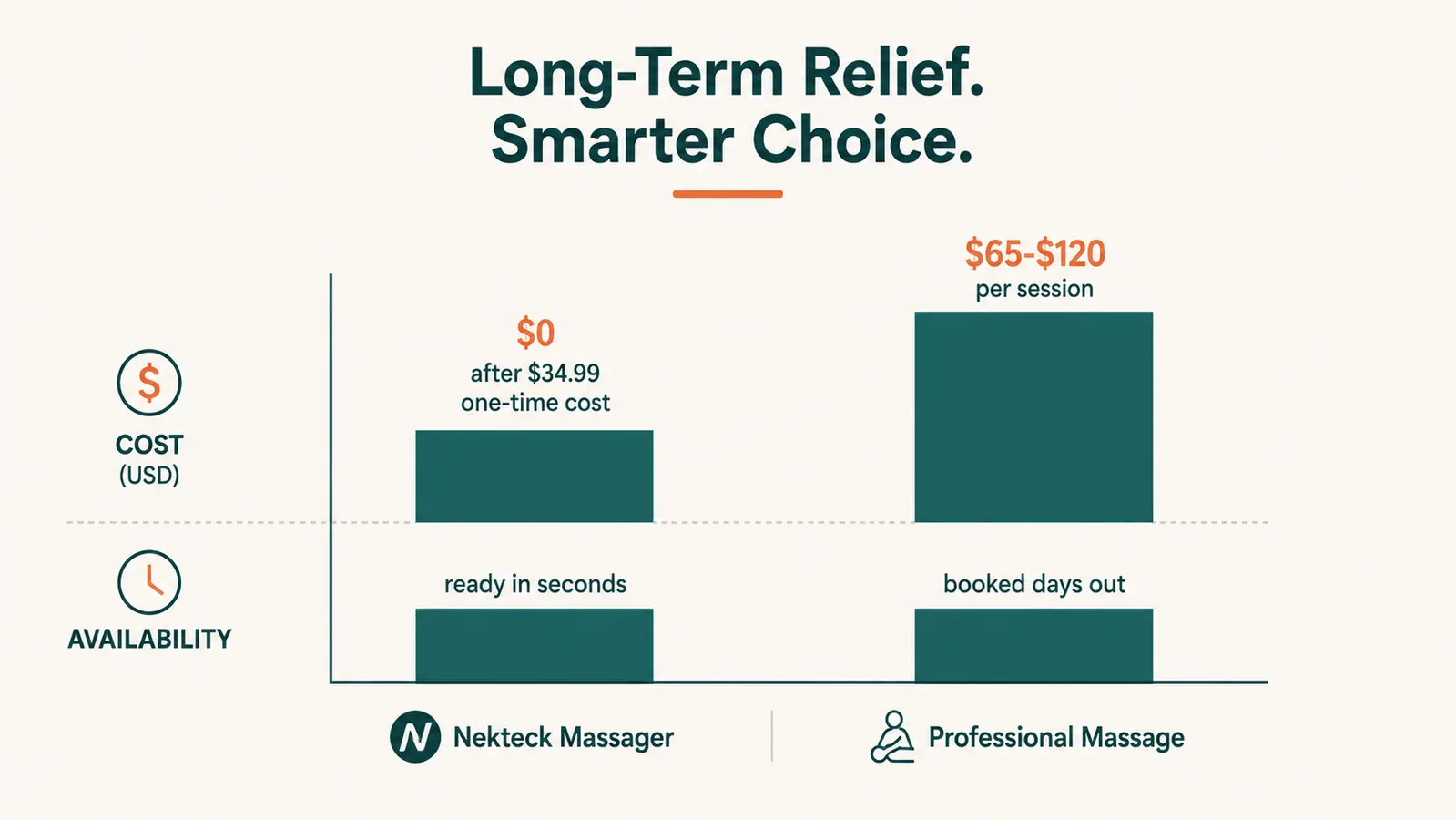
| Cost Per Use | One-time purchase, then free for future use | Costly per session, plus tip, every single visit |
| Availability | Sits in the recliner, ready the second you plug it in, 9pm on a weeknight included | Book days or weeks out, and you work your evening around their calendar |
| Session Length | 15-20 minutes per area, run it twice back to back if you're still tight | Standard appointment is 50-60 minutes, hard stop when the timer's up |
| Pressure Control | 3-speed kneading plus adjustable heat, you dial in exactly what your shoulders can take | A trained therapist reads your body and adjusts pressure by feel as they work |
| Zones Covered | Neck, shoulders, upper back directly, plus a strap extension for lower back, thighs, and calves | Full-body table work in one session, arms and legs included without extra attachments |
| Consistency | Same kneading pattern and heat setting every time you turn it on | Varies by which therapist you get, and how their day's gone before yours |
| Getting There | Plugs into any wall outlet, car adapter included for the truck | Drive to a studio or spa, then account for parking and drive time both ways |
| Human Assessment | No diagnosis, it just kneads wherever you position it | Trained hands can find a knot you didn't know you had and work it directly |
Where the Nekteck Massager Wins
The biggest thing that changed once I had the Nekteck sitting in my living room was timing. My neck doesn't get tight on a massage therapist's schedule, it gets tight by Wednesday afternoon after two straight days of overhead work and a night hunched over paperwork. With the massager, I don't have to white-knuckle it until Saturday's appointment. I get home, plug it in, drop into the recliner, and I'm getting real deep kneading on my neck and shoulders within thirty seconds. That immediacy is worth more to me now than I expected it to be, because the tension never gets the chance to build up into the kind of knot that takes a full hour to work out later.
The cost side is the other obvious one. I was spending professional massage rates per session, and I was going every two to three weeks, so call it substantial monthly spending just on massages. The Nekteck cost less than a single one of those sessions and I've had it running two or three times a week since I bought it. Do that math over six months and it's not close. It also travels. I keep the car adapter in the glove box, so after a long drive back from a fishing trip with my neck stiff from staring at the road for four hours, I can run it in the truck before I even get inside the house.
The heat function ended up mattering more than I expected going in. I figured the kneading nodes were the whole point, but the built-in heat on the neck contact points loosens things up first, so the kneading actually reaches deeper muscle instead of just working the surface. On a cold morning before an early shift, I'll run it for ten minutes with the heat on before I even leave the house, and my range of motion checking blind spots in the truck is noticeably better than it used to be without it.

Where Professional Massage Wins
I'm not going to pretend a machine replaces a trained set of hands. A good massage therapist can find a knot in your lower back you didn't even know was there, work around a healing injury without aggravating it, and adjust pressure moment to moment based on how you're reacting under their hands. The Nekteck kneads the same pattern regardless of what your body's doing that day. If you've got a specific injury, chronic pain that needs a professional eye, or a knot that's deeper than surface muscle, that's a conversation for a licensed therapist, not a device you bought off Amazon.
Full-body coverage in one sitting is the other real advantage. A 60-minute massage can work your neck, shoulders, lower back, hamstrings, and calves in a single session without you moving a strap or repositioning anything. The Nekteck is genuinely built for the neck, shoulders, and upper back, with an extension strap that reaches the lower back and legs if you position it right, but it's still one device doing one thing at a time. If you're the kind of person who's sore everywhere after a long weekend of physical work, hauling gear, splitting wood, whatever it is, a massage table covers more ground in less total effort from you.
Stop scheduling relief around someone else's calendar
The Nekteck gets you real shiatsu kneading and heat on tired shoulders the same night the tension shows up, not whenever the next open slot happens to be. One-time cost, ready in seconds, works from the recliner or the truck.
Amazon Check Today's Price on Amazon →A massage therapist works the whole body once a month. The Nekteck works the neck and shoulders as often as the job actually beats them up, which for me turned out to be a lot more often than once a month.
The Time Cost Nobody Adds Up
Nobody talks about the drive when they're comparing these two things, but it's real money and real time. My old massage place was twenty minutes each way, so a 60-minute appointment actually ate closer to two hours out of my evening once I counted getting there, checking in, and getting home. Add a Saturday morning to that and you've burned half a day for one hour of actual hands-on work. The Nekteck doesn't cost me any of that. I run it while I'm answering messages, watching whatever's on, or just sitting with my boots still on after a shift.
That time savings compounds in a way I didn't expect. Because there's no drive and no appointment to plan around, I actually use the massager more often than I ever used the massage service, even though each individual session is shorter. More frequent short sessions have done more for keeping my neck loose week to week than the occasional long session ever did, mostly because the tension gets addressed before it has a chance to set up shop.
What a Budget Machine Can't Replace
I want to be straight about the limits, because I don't think it's honest to sell this as a full swap. A massage therapist can talk to you about what they're feeling under their hands, whether a muscle feels inflamed versus just tight, whether something needs ice or rest instead of more pressure. That kind of feedback loop matters if you're dealing with an actual injury and not just end-of-week soreness. I still book a real massage a couple times a year, usually after something specific flares up, a pulled muscle hauling a deer out of the woods or a back that's been off for a week straight and isn't responding to heat alone.
The other thing a machine can't do is the relaxation side of it. There's something to lying on a table in a quiet, dim room with someone else doing all the work that a recliner and a plug-in massager just doesn't replicate. If part of what you're paying for is the full sensory reset, not just the muscle work, that's a real difference and it's worth acknowledging instead of pretending the two are identical experiences.

How I Actually Use Both Now
These days the Nekteck handles the routine maintenance and the massage therapist handles the exceptions. Three or four nights a week, if my neck or shoulders are tight from a physical day, I run the massager for fifteen or twenty minutes while I catch up on messages or just sit with my eyes closed. That's kept the day-to-day tension from ever building into something worse. When something actually goes wrong, a strained muscle, a back that's not responding to heat and rest, I book the real thing and let a professional look at it.
That split has cut my massage spending down to maybe three or four visits a year instead of one every couple weeks, and honestly my shoulders feel better managed now than they did when I was only getting worked on once a month and white-knuckling the weeks in between. Frequent small maintenance beats infrequent big fixes, at least for the kind of soreness that comes from doing the same physical work week after week.
Who Should Buy Which
If your soreness is routine, the kind that shows up from repetitive physical work, sitting at a desk, or hauling gear on the weekends, a Nekteck shiatsu massager is going to cover most of what you actually need, and it'll pay for itself against a single month of massage appointments. If you're dealing with a real injury, chronic pain that hasn't responded to heat and rest, or you just want the full-body, hands-on experience a table gives you, book the professional. Most people I know, myself included, land somewhere in the middle, using the machine for upkeep and saving the real appointments for when something's actually gone wrong.
There's no rule that says you have to pick one forever. Start with the machine since it's the lower-cost, lower-commitment option, and see how much of your usual tension it actually handles before you decide whether you still need the recurring appointment on top of it.
Give your neck the same attention your wallet's been giving the massage studio
The Nekteck plugs in anywhere, dials in the pressure and heat you actually want, and never once asks you to work around somebody else's schedule. It won't replace a real therapist for the tough stuff, but it'll handle the every-week tightness for a fraction of what one appointment costs.
Amazon Check Today's Price on Amazon →